Autonomous Delivery Vehicles Enter Households: How Zelostech Is Reshaping the Logistics Ecosystem.Autonomous Delivery Vehicles Enter Households: How Zelostech Is Reshaping the Logistics Ecosystem.Autonomous Delivery Vehicles Enter Households:
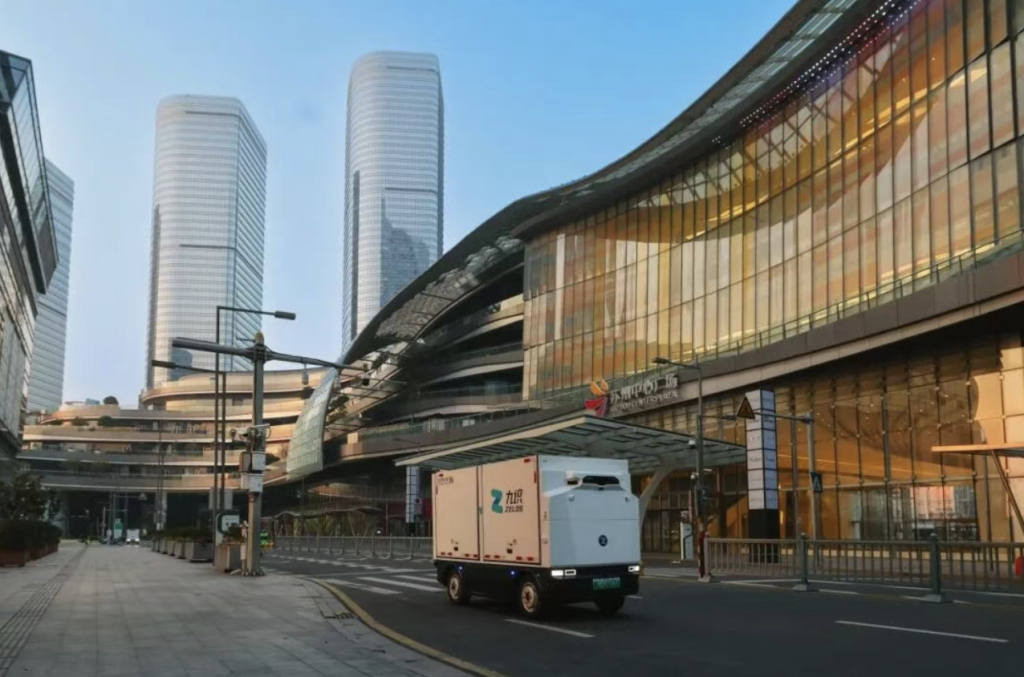
At 10:00 a.m. on August 29, an autonomous logistics vehicle bearing the “Zelostech” logo slowly pulled out of the ZTO Express . After confirming the lane ahead was clear, it quickly turned left into the main road and headed steadily toward a parcel pickup station on its planned route. This is no longer a futuristic vision, but an everyday reality.
By August 2025, Zelostech’s autonomous delivery vehicles had completed 300 million orders with cumulative safe mileage surpassing 30 million kilometers—the equivalent of circling the Earth 750 times. Remarkably, this achievement took only four years. Founded in August 2021, Zelostech has launched seven generations of autonomous vehicle products, which now operate routinely on city roads with fully driverless commercialization.
How did Zelostech achieve these results?
A New Era of Smart Logistics
Early in the morning at the ZTO Express Wusongjiang branch in Kunshan, station manager Yang Huitian taps his smartphone app, and a Zelostech Z5 autonomous logistics vehicle sets off toward a parcel station. This vehicle, which only began service in June 2025, has delivered 80,000 parcels in under three months, improving efficiency by 27%.
“Now we can dispatch as soon as goods are loaded, and departure frequency has increased to at least twice daily depending on volume,” Yang told Auto News. The vehicles not only solve timeliness issues but also eliminate late-delivery penalties caused by waiting for trucks to fill. Misrouted parcels that used to take a full day to return can now be corrected the same day, improving both efficiency and customer satisfaction.
Traditionally, urban logistics network operates on three tiers: from transfer/distribution centers to delivery stations, and then to last-mile parcel lockers. Kunshan’s Wusongjiang branch is a mid-tier station. Yang explained that the old model relied on 4.2-meter box trucks and electric tricycles. Trucks often departed underloaded, raising costs, or delayed departures, risking fines for late deliveries. Electric tricycles posed safety risks, especially in extreme weather, and during peak shopping festivals, branches struggled to find temporary drivers.
After deploying Zelostech vehicles in June, Yang saw efficiency rise, penalties disappear, and costs fall.
Autonomous delivery is now spreading rapidly nationwide. More than 100 provinces and cities have adopted deployment scenarios, covering over 80% of major logistics hub cities and serving over 100 niche applications. Zelostech alone has rolled out vehicles in 32 provinces and nearly 300 cities, as well as Singapore, Japan, South Korea, the Middle East, and Europe, serving 600+ clients across industries including parcel express, fresh food, supermarkets, pharma cold chain, bakery, and auto parts.
According to Zelostech, its autonomous vehicles reduce client operating costs by an average of 66%. For example, one courier station using five vehicles now handles 10,000 parcels daily.
The impact goes beyond efficiency. With courier workforce numbers falling—362,000 nationwide in Q1 2025, down 31,000 from late 2024—autonomous delivery is filling a critical labor gap.
Zelostech’s electric vehicles also support sustainability. Each reduces about 10kg of CO₂ per day, and annual emissions savings equal planting nearly 10,000 acres of forest. In Sichuan’s Liangshan region, the vehicles deliver 1,500 parcels daily, cutting costs by 60% and reducing emissions by 3.5 tons monthly, while supporting rural e-commerce like “oranges leaving the village.”
“We want ‘24-hour delivery’ to be a universal right, not a city privilege,” said Zelostech. “We see ourselves as guardians of local livelihoods and drivers of new productive forces, turning technology into social impact and aligning brand value with social value.”
First Principles: Dual Engines of Technology and Business
How did a startup like Zelostech grow into an industry leader in just four years?
Co-founder Zhuang Li, now head of algorithms, worked for years in Silicon Valley as an early autonomous driving developer and Apollo contributor. After losing his job in July 2021, he founded Zelostech in Suzhou Industrial Park, drawn by its strong AI ecosystem. CEO Kong Qi, after years in Silicon Valley, also returned in late 2021, motivated by Shanghai–Suzhou’s innovative environment and proximity to family.
The team now numbers nearly 1,000 employees, with an average age of 32, bringing experience from Baidu, Huawei, Waymo, Apple, and leading universities.
Zelostech prides itself on first-principles thinking and full-stack R&D. Its in-house capabilities span L4 algorithms, product development, vehicle delivery, and lifecycle operations. Technologies include OCC fusion detection, multi-scenario pre-decision algorithms, and distributed scheduling, cutting inference latency to under 50ms and enabling robust adaptation to complex urban roads. Vehicles integrate LiDAR, cameras, radar, and ultrasonic sensors, operating reliably in temperatures from -30℃ to +55℃ for over five years.
Innovation in business models is equally key. “Our clients aren’t buying cars—they’re buying AI Drivers, or transport capacity,” Kong explained. Subscription-based services lower entry barriers for logistics companies, turning upfront costs into manageable operational expenses.
Zelostech validated its business model by comparing human and autonomous delivery in a Meituan warehouse. The success paved the way for scaled commercialization. With daily operations now adding 200,000 km of mileage, data accumulation has become another moat, fueling a cycle of “more data → better tech → more clients.”
“Data is the ultimate barrier,” said Kong. “Only real-world, large-scale deployment can drive the iterations that make autonomous driving safe and efficient.”
Building the Future Transport Network
Autonomous delivery, as the “capillaries” of smart urban transport, has reached an inflection point of scaled growth. Yet challenges remain. Zelostech is pursuing a bold vision.
In August, it launched the ADS Center (Autonomous Driving Service) program, creating an integrated smart logistics platform. Based on standardized vehicles, it enables clients to design customized ecosystems and provide on-demand transport capacity services. This marks Zelostech’s shift from a technology provider to a builder of smart city logistics ecosystems.
The ADS Center rests on four pillars: standardized vehicles, customized services, transport service networks, and new urban infrastructure. Together, they drive deep integration of vehicle–road–cloud–city systems.
Zelostech now offers three product lines:
- Z-series: “all-rounder” for urban logistics
- E-series: specialized for light parcels
- L-series: heavy-load, high-efficiency, led by the L5 with a record-breaking 1.8-ton capacity
The company expects to deliver over 10,000 vehicles in 2025.
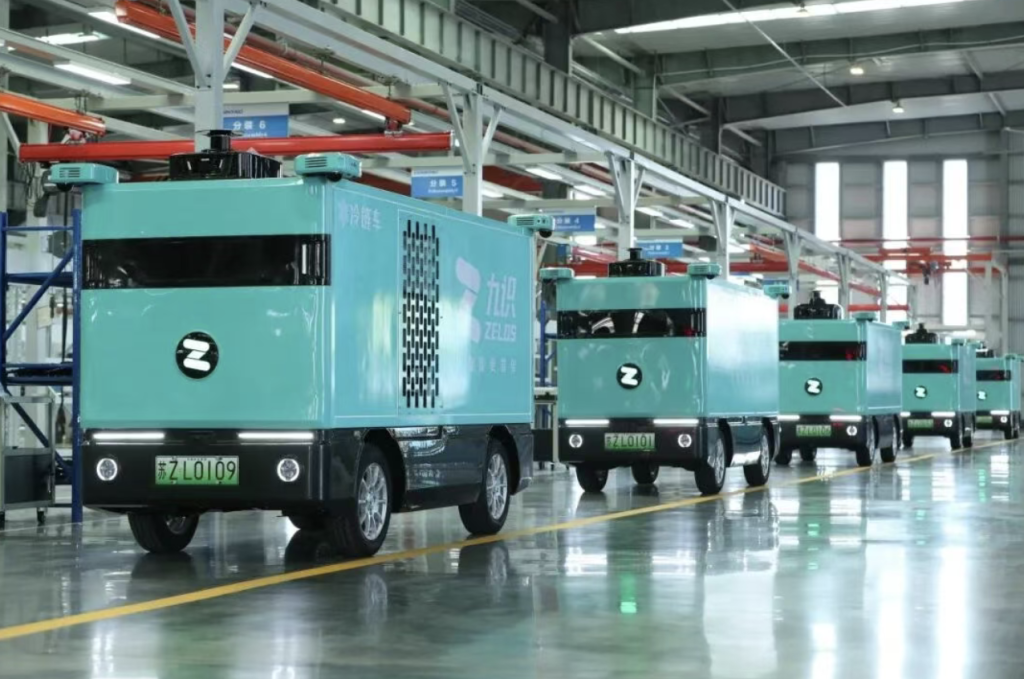
Zelostech is also building three ecosysetms:
- Smart vehicle supply chain (sensors, LiDAR, etc.)
- Special-purpose vehicles (retrofits, sanitation, security)
- Transport capacity services
The company has R&D centers in Suzhou, Beijing, and Silicon Valley, forming a global collaboration network. Its April $300M Series B funding supports next-gen R&D, supply chain building, market expansion, and ecosystem development.
Talent cultivation and social responsibility are also priorities. Zelostech is creating new hybrid roles like “autonomous driving algorithm + carbon accounting,” and with Tmall AutoCare, it will train 2,000 smart vehicle technicians by 2026.
Globalization is accelerating. On September 3, Zelostech and ALS launched the first public-road pilot of autonomous logistics in Malaysia, showcasing the country’s first L4 logistics vehicle. Zelostech also secured Singapore’s first autonomous logistics license, revised TR-68 standards, signed a joint venture with Emirates Post Group, and gained clients in Austria.
“Our vehicles deliver flowers at Singapore’s Gardens by the Bay and are in talks with Changi Airport,” Kong revealed. “As we expand globally, we will pursue localized innovation.”
Today, Zelostech’s wheels are already turning. Autonomous delivery has moved from concept to reality, from experiments to scaled commercialization. It is reshaping not only the logistics industry but also urban life and rural economies.